Acupressure mats produce a strong, prickly sensation that many people find relaxing once the first few minutes pass. A handful of small trials report lower pain ratings in people with long-standing neck or back pain, but none used a convincing placebo, and in healthy adults a mat did no better than simply lying down to relax. Treat a mat as a relaxation tool, not a treatment.
An acupressure mat is a padded rectangle covered in small plastic spikes. You lie on it, it prickles, and after a few minutes the sting gives way to something duller that many people find calming.
The marketing promises a great deal. The research is small and more modest. This guide goes through every published study we could find, then covers how to use a mat, how long to stay on it and who should check with a doctor first.
What is an acupressure mat?
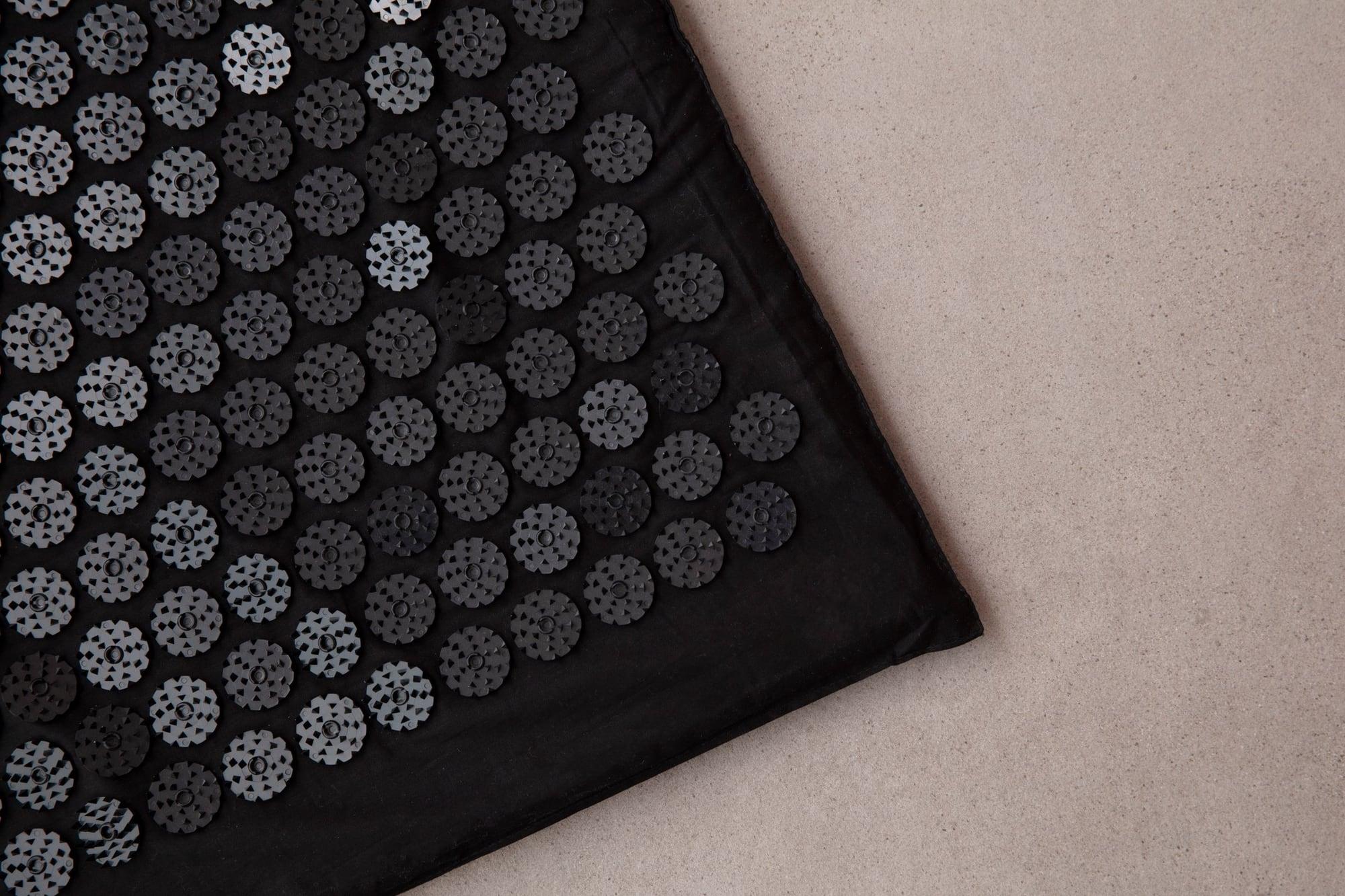
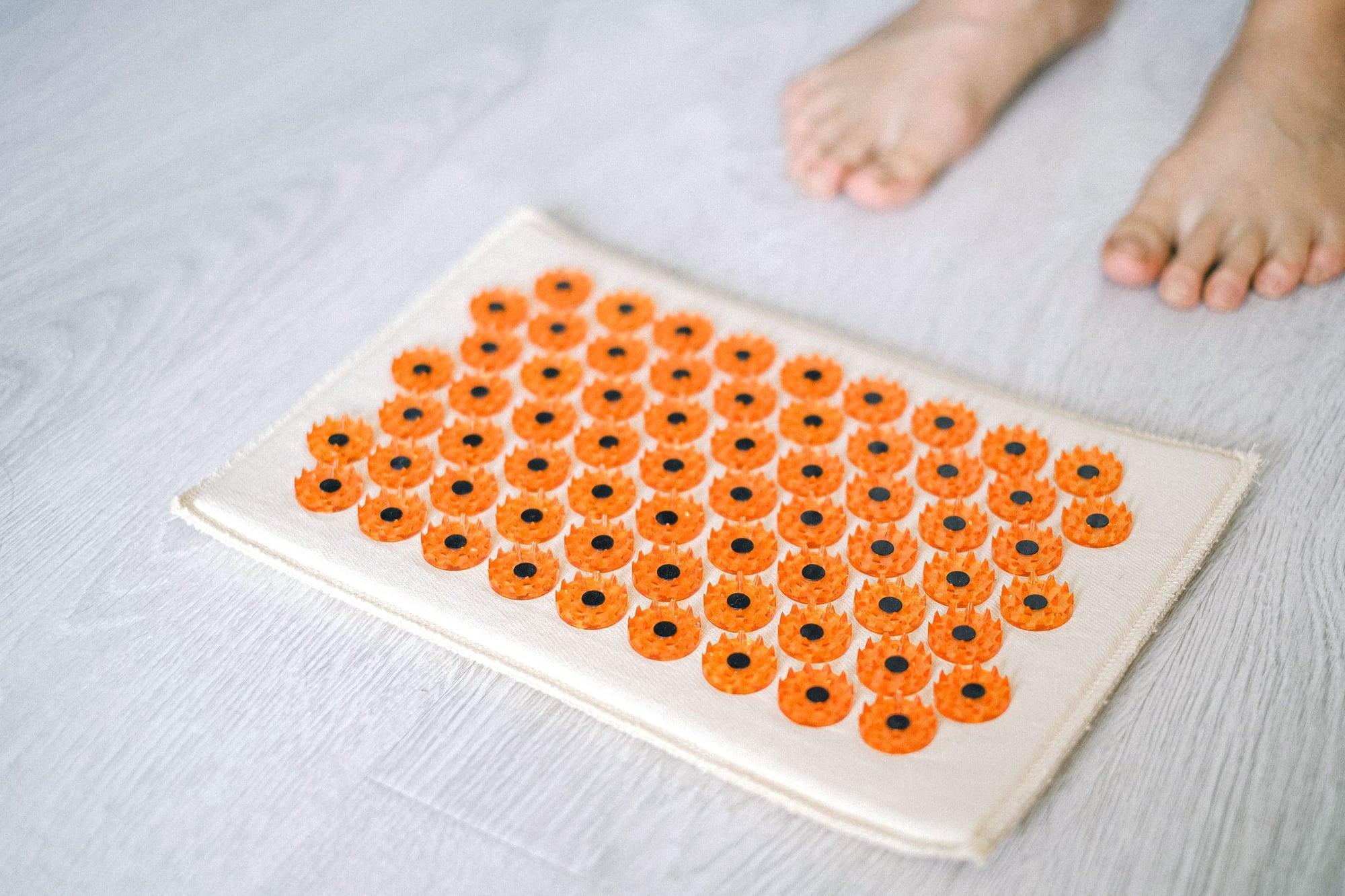
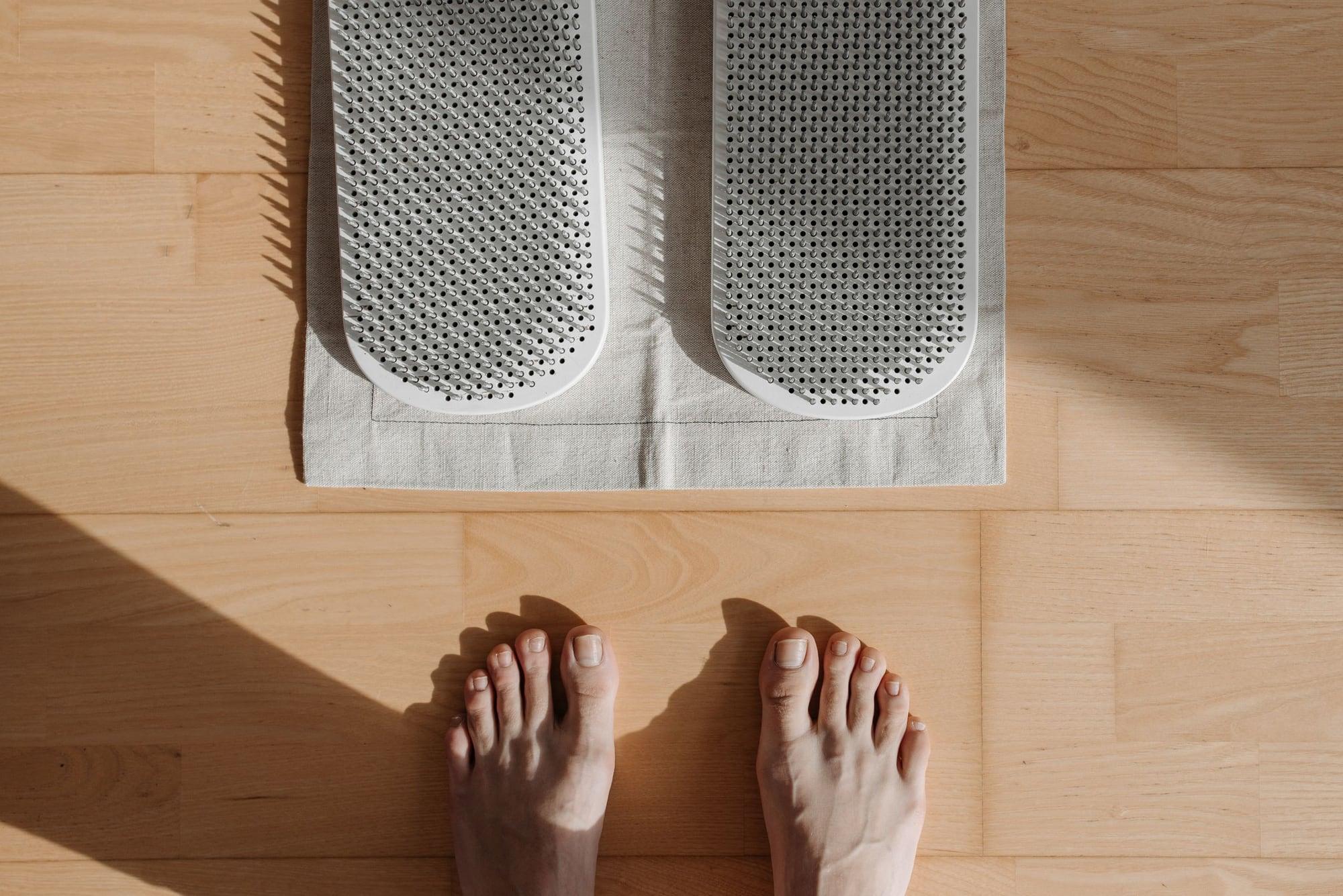
Most mats are a foam cushion in a fabric cover, with rows of small plastic spike discs sewn on. They are also sold as spike mats, nail mats and beds of nails. [2]
Sizes and spike counts vary a lot. One mat used in two of the studies below has 6,210 plastic points spaced about 5 mm apart. [3] The pad used in a pair of German trials was far smaller, 22 by 33 cm, with 1,140 spikes. [1]
The name borrows from acupressure, which the US National Cancer Institute defines as applying pressure or localized massage to specific sites on the body. [6] A mat is less selective than that. It presses on whatever skin touches it.
Do acupressure mats work?
For winding down, many people like them. For anything medical, the research is thin.
A search of PubMed and of the papers' own reference lists turned up six published papers, most of them small, and no systematic review devoted to mats.
Study
Who took part
What they did
What changed
Hohmann and colleagues, 2012 (two pilot trials)
82 adults with chronic neck or low back pain
A small spike pad for about 30 minutes a day for 14 days, or a waiting list
Pain ratings fell more in the pad groups. A back disability score did not change
Kjellgren and colleagues, 2011 (pilot trial)
Adults with muscle tension pain
A mat for 15 minutes a day for three weeks
Worst-pain ratings fell. Average pain, sleep, stress and mood did not change
Olsson and von Schéele, 2011 (lab study)
32 healthy adults
Single sessions on a mat, with and without relaxation audio
Pain peaked within 30 seconds, then faded. Cortisol did not differ
Saha and colleagues, 2016 (no control group)
91 adults with chronic or recurring low back pain
A spike pad daily for two weeks
Brief relief right after each session. No lasting change in pain intensity
Frizziero and colleagues, 2021 (trial)
44 adults with chronic low back pain
An exercise program, with or without a mat for 60 minutes a day
Both groups improved. The gap between them on the main pain score was not statistically significant
Kisker and Schöne, 2024 (trial)
62 healthy students
20 to 30 minutes, three times a week for three weeks, with or without a mat
Stress and sleep ratings improved a little in both groups, with no difference between them
Sources for the rows, in order: [1][2][3][4][5][2]. The journal page for the 2011 pilot trial is no longer online, so that row relies on the summary given by the authors of the 2024 trial.
For neck and back pain
The strongest-looking result comes from Germany. In two pilot trials, 82 adults with long-standing neck or low back pain were randomly assigned to use a spike pad at home or to wait. After 14 days, pain ratings on a 0 to 10 scale were about 1.6 points lower than the waiting group's for neck pain and about 2.3 points lower for back pain. [1]
Read that with three limits in mind. The comparison was a waiting list, so nobody was blinded and there was no placebo. The trials were small and lasted two weeks. And in the back pain trial, a standard score for how much pain limits daily life did not improve. The researchers note that no convincing sham version of a spike pad exists, because even blunted spikes still press hard on the skin. [1]
Later studies are cooler. In 2016, researchers followed 91 adults with chronic or recurring low back pain who used a pad daily for two weeks, with no control group. People reported relief right after a session, but pain intensity at two weeks and at 14 weeks was not significantly different from the start. [4]
A 2021 Italian trial gave 44 adults with chronic low back pain a supervised exercise program, and half of them also used a mat for 60 minutes a day. Both groups improved. On the trial's main pain measure, the difference between the groups over time did not reach statistical significance, while a quality-of-life score did favor the mat group. The authors list the small sample, the lack of a sham mat and self-reported use as limits. [5]
For context, the evidence for hands-on massage is not strong here either. The US National Center for Complementary and Integrative Health (NCCIH) says evaluations of massage for low-back pain have found only weak evidence that it may be helpful. [7]
So the fair position is this. A few small trials hint that some people with chronic neck or back pain rate their pain lower while using a mat, and none of them can separate the mat from expectation. That is not proof that a mat treats back pain.
For stress and relaxation
Two studies looked at healthy people. In the 2011 lab study, 32 adults lay on a mat under different conditions. Pain ratings peaked within 30 seconds and then faded, and self-rated relaxation rose over time. It rose in the sessions without the mat as well. Blood pressure was higher and heart rate slower on the mat, and the stress hormone cortisol, measured in saliva, did not differ. [3]
The best-controlled trial so far was published in 2024. Sixty-two healthy students practiced relaxing in the evening, three times a week for three weeks, half on a mat and half on their own bed with no tools. Perceived stress fell by about 7 percent across both groups, while blood pressure, heart rate and pain tolerance did not change. No measure showed a significant difference between the groups. [2]
The authors' reading is that taking time to relax helped a little, whatever the method. They add that any benefit specific to mats may be tied to particular problems such as tension pain, which their trial did not test. A manufacturer supplied the mats and, the paper states, received no payment. [2]
For sleep
Sleep is the benefit people ask about most, and it has the least support. In the 2024 trial, self-rated sleep quality improved by about 8 percent across both groups, again with no difference between mat and no mat. The authors caution that the sleep questionnaire performed poorly in their sample. The 2011 pilot trial, as they summarize it, found no change in sleep quality at all. [2]
If a mat is how you like to wind down, keep doing it. It has not been shown to work better than any other quiet 20 minutes. Our sleep hub covers other bedtime habits.
Acupressure mat benefits: what holds up
A strong sensation that settles into calm. Well documented. Whether the mat adds anything to lying still is unproven.
Lower pain ratings with chronic neck or back pain. Reported in small trials with no placebo comparison.
Lower stress. No better than relaxing without a mat in the one controlled trial.
Better sleep. Not supported so far.
Everything else. Weight loss, nausea, period cramps and the other uses people search for have not been tested in any mat trial we could find.
How to use an acupressure mat
There is no official method. The steps below follow what the trials asked participants to do.
Put the mat on a bed or sofa first. The German trials and the 2024 trial both had people use the mat on a bed. [1][2] A hard floor feels sharper.
Start with a thin shirt on. Trials let people keep a thin layer on while they got used to the spikes. [2][5]
Lower yourself slowly. Sit at the bottom edge, then roll down so your weight spreads across as many spikes as possible.
Expect a rough start. Participants in the German trials were told that the first 2 to 5 minutes could be painful. [1] Breathe slowly and let it settle. If it stays sharp, get off.
Get up slowly and look at your skin. A pattern of pink dimples is expected and should fade. Broken skin is a sign to stop.
How long should you lie on an acupressure mat?
Nobody has tested which duration works best. Each trial simply picked one: 15 minutes a day in the 2011 pilot trial, about 30 minutes a day in the German trials, 20 to 30 minutes three times a week in the 2024 trial, and 60 minutes a day in the Italian trial. [2][1][5]
Start with a few minutes, add time only while it stays comfortable, and do not read the longer trial times as a target.
Side effects and who should check first
The main side effect is the obvious one: lying on spikes hurts at first. In the 2016 study, eight of 91 people found the pad too painful to continue, and one reported temporary itching and redness. [4]
The trials also show who researchers were not willing to enroll. People were left out for skin disease or skin damage where the mat would touch, a tendency to bleed or use of blood thinners, corticosteroid medication, insulin-dependent or uncontrolled diabetes, and pregnancy. [1][5] Manufacturers' own guidance, as reported in the 2024 trial, advises against use during pregnancy, with blood thinners and with cardiovascular disease. [2] The lab finding that blood pressure was higher on the mat points the same way. [3]
If any of those describe you, ask your doctor before you try one.
One more line from the NCCIH applies to mats as much as to massage: do not use it to postpone seeing a health care provider about a medical problem. [7]
If it is your feet you want to press
A mat is built for backs. It can be used on feet too, and we cover that in acupressure mats for feet. It is the more intense option, and it reaches your back, neck and shoulders, which nothing worn on the foot can do.
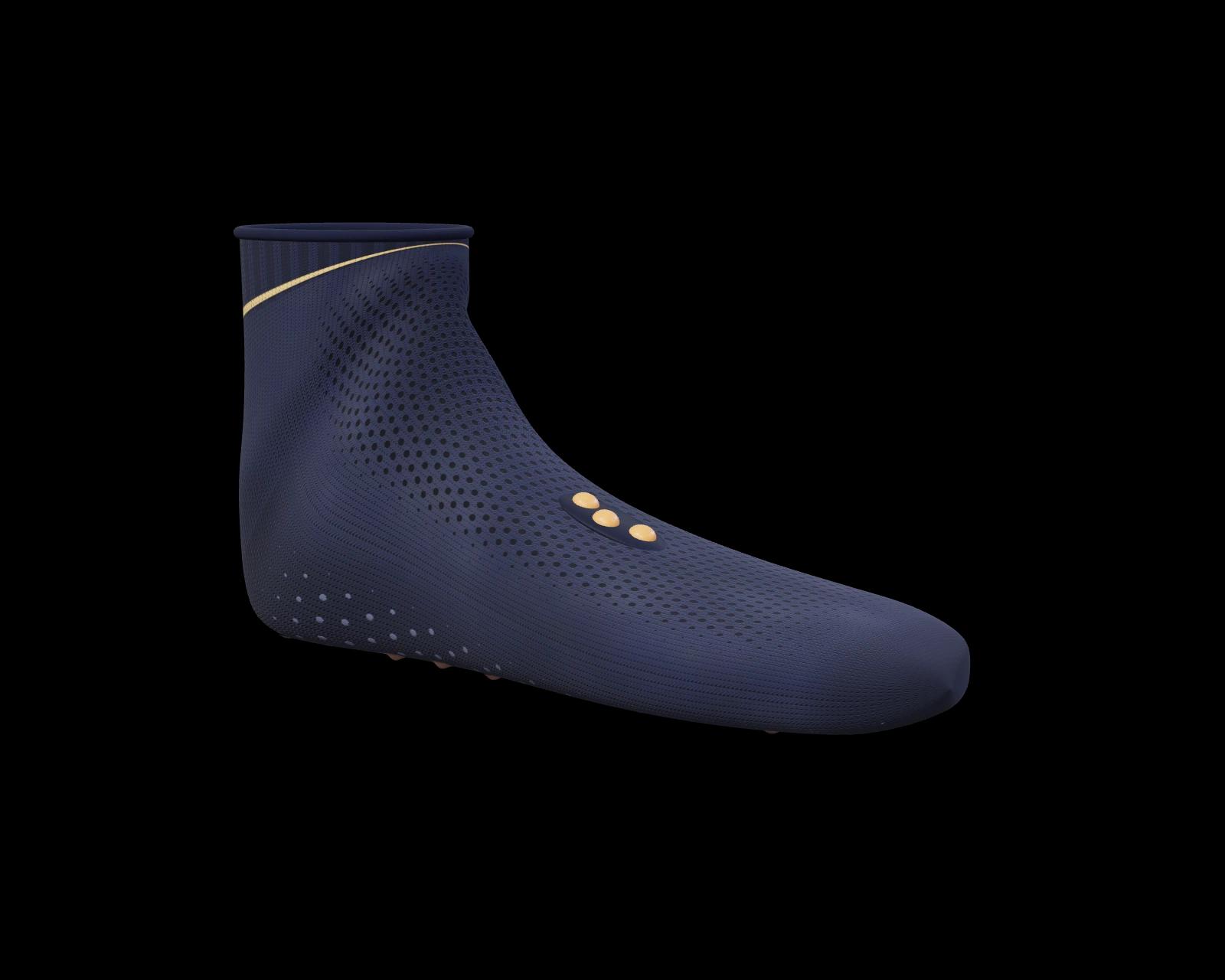
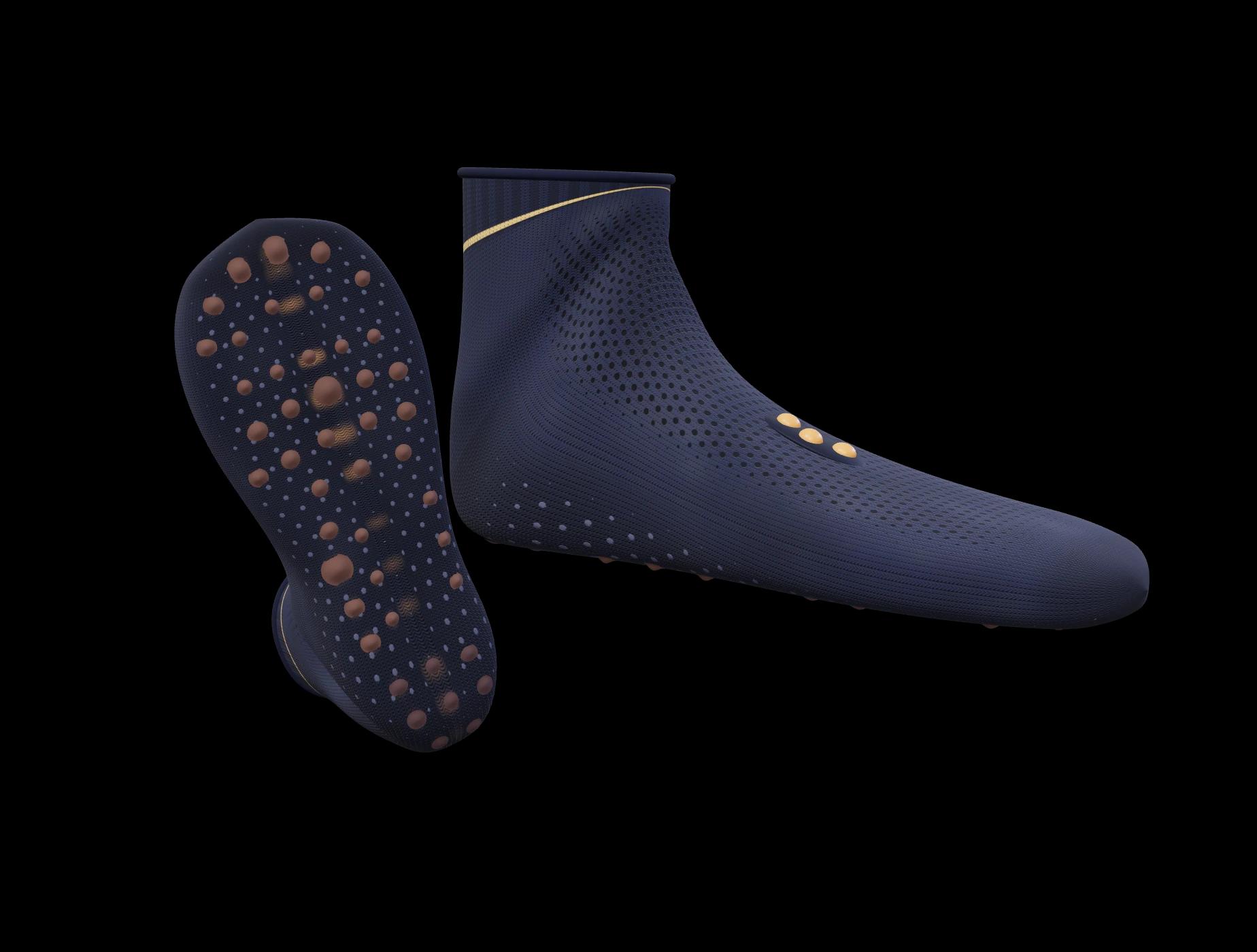
We make a gentler tool for a narrower job, so weigh this section accordingly. Somnisole is a thin, breathable sock with 45 firm silicone nubs bonded inside the sole, covering the toes, the toe groove, the ball, the inner arch, the outer edge and the heel. They are nubs, not spikes, and the softest sit at the heel. It is made for achy, tired, restless-feeling feet at bedtime: you lie in bed and press your soles into a wall or footboard, sole to sole, or one sole over the other foot's instep. Our how it works page shows each position.
Where Somnisole's 45 nubs sit: toes, toe groove, ball, inner arch, outer edge and heel.
The same honesty applies to us. Somnisole is a pre-order that has not shipped, so there are no customer reviews, test results or trials. The nubs are mapped to every reflexology zone, and each zone is traditionally associated with another part of the body. The NCCIH says the claim that pressing these points brings relaxation and healing to those body parts has not been proven. [8] What people reliably report is simpler: firm pressure on the feet feels good.
Not for feet with numbness, open wounds, diabetes-related foot problems or poor circulation without a doctor's OK.
They work as a way to create intense, prickly pressure that many people find relaxing after the first few minutes. Small trials in people with chronic neck or back pain reported lower pain ratings than a waiting list, but those trials could not rule out placebo effects. In a 2024 trial of healthy students, three weeks on a mat did no better than three weeks of relaxing without one.
How long do you lay on an acupressure mat?
There is no researched ideal time. Published trials have used 15 minutes a day, about 30 minutes a day, 60 minutes a day, and 20 to 30 minutes three times a week. Most people start with a few minutes over a thin shirt and add time only while it stays comfortable.
What is an acupressure mat?
It is a padded mat, usually foam in a fabric cover, studded with hundreds or thousands of small plastic spikes. You lie, sit or stand on it so the spikes press into your skin without piercing it. The same product is also sold as a spike mat, a nail mat or a bed of nails.
What are the side effects of an acupressure mat?
The common one is discomfort or pain in the first minutes, which usually fades as you settle. In one study of 91 adults, eight found the pad too painful to keep using and one reported temporary itching and redness. Trials have left out people with skin problems where the mat touches, bleeding tendencies or blood thinners, and insulin-dependent diabetes, so ask a doctor first if any of those apply to you.
Can an acupressure mat help you sleep?
There is no good evidence that it does. In a 2024 trial, self-rated sleep improved slightly both in people who lay on a mat and in people who simply lay down to relax, with no difference between them, and an earlier pilot trial found no change in sleep quality. If a mat is how you like to wind down, that is a fine reason to use one, but it is not a sleep treatment.
Do acupressure mats work for back pain?
The evidence is early and mixed. Two German pilot trials found lower pain ratings after two weeks compared with a waiting list, while a later study without a control group found only short-lived relief right after each session and no lasting change in pain intensity. Ongoing back pain is worth showing to a doctor or physical therapist.
8Reflexology. National Center for Complementary and Integrative Health (NCCIH), NIH. Accessed 2026-11-06.
The sock with the chart built in.
Somnisole puts firm silicone nubs over every zone of the sole, inside a sock thin and breathable enough to sleep in. Made for achy, tired, restless-feeling feet at bedtime.
Somnisole is a wellness product, not a medical device. Not for feet with numbness, open wounds, diabetes-related foot problems or poor circulation without a doctor's OK.