Right foot shown. Numbers match the list below. Points are in the same place on the left foot, mirrored.
Two maps of the same foot
When people search for pressure points on the feet they usually mean one of two things. Acupressure is the practice of applying pressure to specific points on the body[1]. It comes from traditional Chinese medicine and uses the same points as acupuncture, each with a code (KI 1, LR 3) and a name. Reflexology is a different system that divides the sole into broad zones, each traditionally associated with a part of the body.
This page covers the points. For the zones, see the interactive foot reflexology chart.
Seven pressure points on the feet
We give each point's location and how to press it. We do not list the conditions each one is traditionally used for, because none of those uses has been proven.
- 1
Yongquan (Bubbling Spring) KI 1
Where. On the sole, in the hollow that appears just behind the ball of the foot when you curl your toes, in line with the gap between the second and third toes.
How. Press in with your thumb and hold for a slow count of ten, then make small circles. Repeat three or four times.
- 2
Taichong (Great Surge) LR 3
Where. On top of the foot, in the hollow between the bones of the big toe and the second toe, about two finger-widths back from the web between them.
How. Slide a fingertip back from the web until it drops into the hollow, then press and hold.
- 3
Neiting (Inner Court) ST 44
Where. On top of the foot, in the web between the second and third toes.
How. Pinch the web gently between thumb and forefinger and hold.
- 4
Zulinqi (Foot Overlooking Tears) GB 41
Where. On top of the foot, in the hollow just behind the point where the bones of the fourth and little toes meet.
How. Press with a fingertip and hold. This one is often tender, so start lightly.
- 5
Gongsun (Grandfather Grandson) SP 4
Where. On the inner edge of the foot, in the hollow about a thumb-width behind the base of the big toe joint, where the arch begins.
How. Hook your thumb under the edge of the arch bone and press upward and in.
- 6
Taixi (Great Stream) KI 3
Where. On the inner ankle, in the hollow halfway between the tip of the ankle bone and the Achilles tendon.
How. Rest your thumb in the hollow and press gently. Keep it light: the skin here is thin.
- 7
Kunlun (Kunlun Mountains) BL 60
Where. On the outer ankle, in the hollow between the tip of the ankle bone and the Achilles tendon. It sits opposite KI 3.
How. Pinch the two hollows either side of the tendon between thumb and forefinger. Traditionally avoided in pregnancy.
How to press a point
Find the hollow
Almost every point sits in a small dip between bones or tendons. Slide a fingertip slowly over the area until it settles into the hollow.
Press straight in
Use the pad of your thumb. Lean in gradually until the pressure feels strong but comfortable. It should never be sharp.
Hold and breathe
Hold for a slow count of ten while you breathe out, then ease off. Small circles are fine too.
Repeat and switch
Do three or four rounds on each point, then the same points on the other foot.
What pressing these points can and cannot do
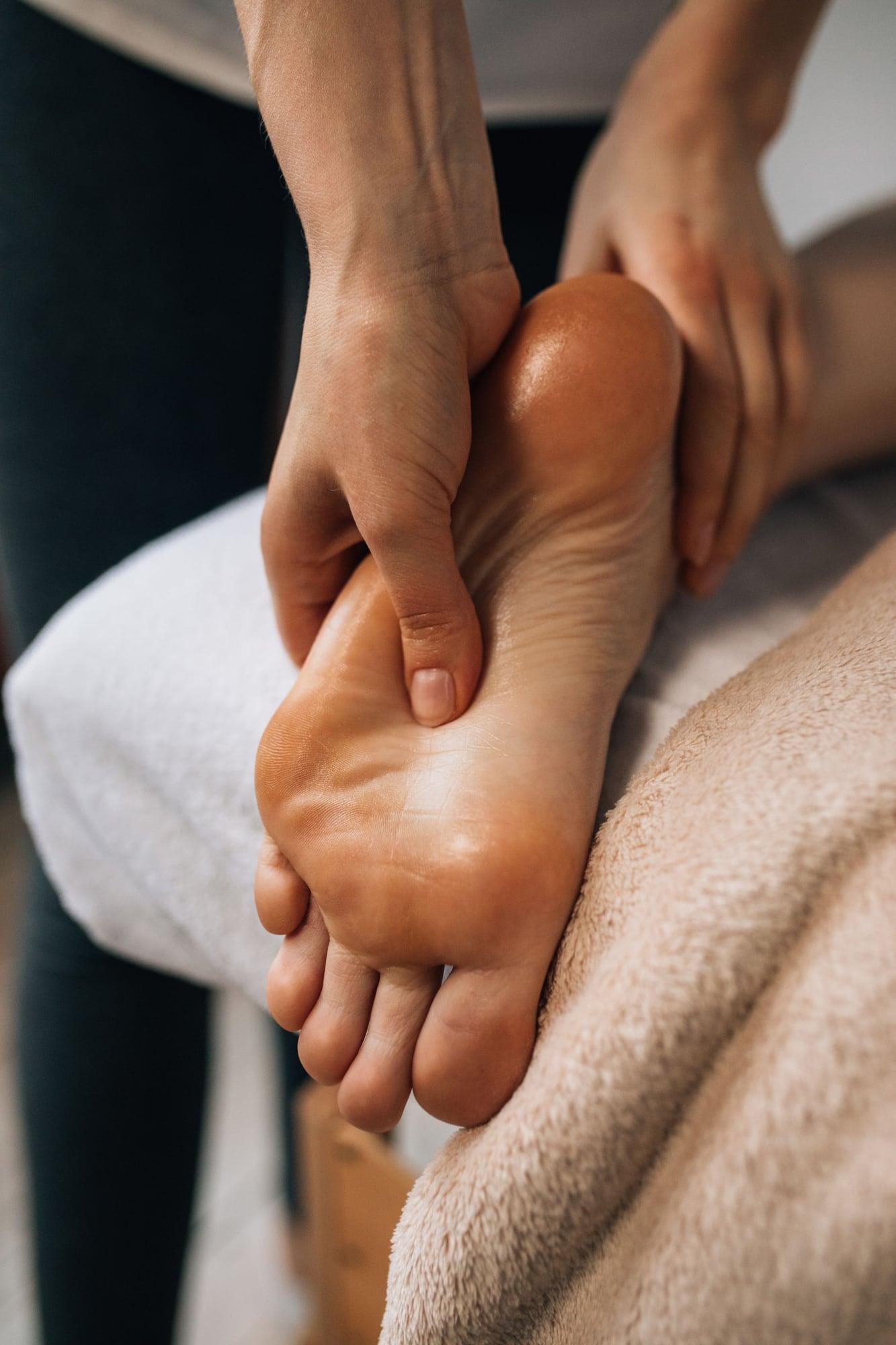
Pressing a point on your foot has not been shown to change anything elsewhere in your body. The U.S. National Center for Complementary and Integrative Health says the claimed effects of foot reflexology on other body parts have not been proven[2], and a systematic review of 18 randomized trials found no convincing evidence that it treats any medical condition[3].
What pressure does reliably is feel good. Having your feet pressed and rubbed is relaxing[7], and massage in general carries a low risk of harm[4]. That is a perfectly good reason to do it, especially at the end of a day on your feet. Treat the points as a map for where to press, not as buttons that fix things.
When to skip it
Do not work on a foot with a fracture, an unhealed wound or active gout, or if you have a blood clot, and check with your doctor first if you are pregnant or have a circulation problem[5]. Not for feet with numbness, open wounds, diabetes-related foot problems or poor circulation without a doctor's OK.
Pressure without the thumb work.
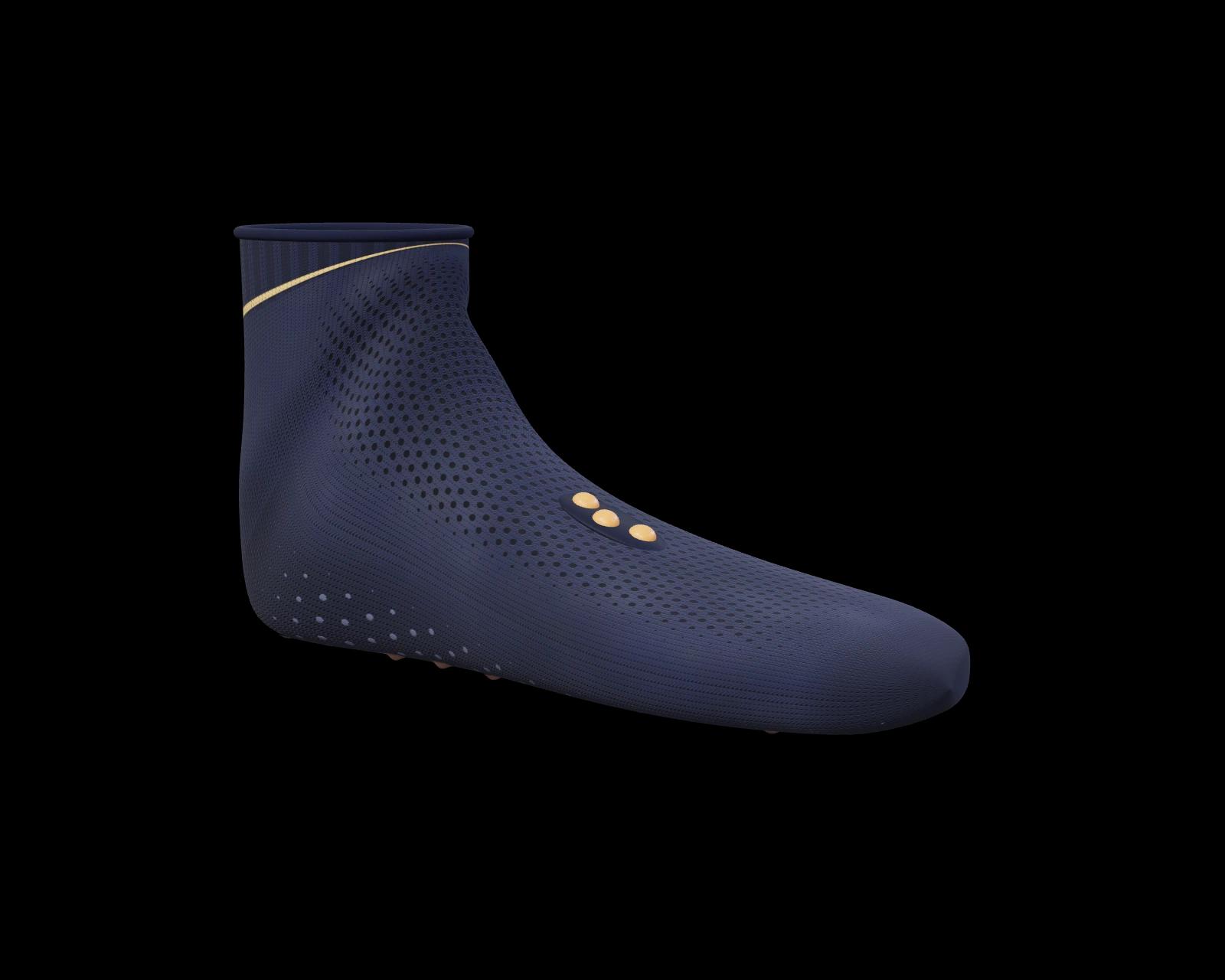
Somnisole puts 45 firm nubs across the whole sole, including one right at point 1, behind the ball of the foot. Press into a wall, a footboard or your other foot and the sock does what your thumbs would. It is thin and breathable enough to fall asleep in.
Somnisole is a wellness product, not a medical device. Not for feet with numbness, open wounds, diabetes-related foot problems or poor circulation without a doctor's OK.
Questions about foot pressure points
Is there a pressure point in your foot?
Yes, many are charted. Acupressure names points along lines called meridians, including one on the sole just behind the ball of the foot. Reflexology divides the whole sole into zones. Both are traditions: research has not shown that pressing a point on the foot affects another part of the body. Firm pressure on the feet does feel good, which is reason enough for most people.
How long should a foot massage last?
For self-massage, five to ten minutes a foot is plenty. Professional reflexology sessions typically run 30 to 60 minutes. There is no proven ideal length, so let comfort decide.
How to relieve foot pain in 30 seconds?
No pressure point reliably relieves foot pain in 30 seconds. What can feel good quickly is taking the weight off your feet, flexing and circling your ankles, and pressing your sole into something firm for a few slow breaths. Pain that is severe, sudden or keeps coming back needs a doctor or podiatrist, not a pressure point.
What are the forbidden acupuncture points in pregnancy?
Traditional acupuncture teaching names a short list of points to avoid during pregnancy, and several of them sit around the ankle and the little toe. Whether pressing them carries real risk is not settled. The sensible rule is simple: if you are pregnant, ask your doctor or midwife before working on your feet and ankles.
What is the difference between acupressure points and reflexology zones?
Acupressure comes from traditional Chinese medicine and uses small, specific points, many of them on the top of the foot and around the ankle. Reflexology is a twentieth-century Western system that maps broad zones across the sole. You press a point; you work a zone.
Who should not press points on their feet?
Skip it on a foot with a fracture, an unhealed wound or active gout, and if you have a blood clot. Not for feet with numbness, open wounds, diabetes-related foot problems or poor circulation without a doctor's OK.
Sources
- 1acupressure (NCI Dictionary of Cancer Terms). National Cancer Institute, NIH.
- 2Reflexology. National Center for Complementary and Integrative Health (NCCIH), NIH.
- 3Is reflexology an effective intervention? A systematic review of randomised controlled trials. Medical Journal of Australia, 2009.
- 4Massage Therapy: What You Need To Know. National Center for Complementary and Integrative Health (NCCIH), NIH.
- 5Are There Times When I Shouldn't Have Reflexology?. University of Minnesota, Taking Charge of Your Wellbeing.
- 6What Can I Expect in a First Reflexology Visit?. University of Minnesota, Taking Charge of Your Wellbeing.
- 7Reflexology: What It Is and How It Works. Cleveland Clinic Health Essentials.