Yoga nidra is a guided relaxation practice done lying down, in which a voice leads your attention through your body, your breath and simple images while you stay loosely aware. Small studies link it with better self-rated sleep, but the evidence is early and it is not an established treatment for insomnia. To try it tonight, get into bed, play a 10 to 20 minute recording and follow along.
Yoga nidra asks very little of you. You lie down, press play and listen. That makes it one of the easier relaxation practices to try on a night when your body is tired and your head is not.
This guide covers what yoga nidra is, where it comes from, how to try it tonight, and what published research says about it and sleep, including where that research runs out. It sits with the other bedtime guides in our sleep hub.
What is yoga nidra?
Yoga nidra is a guided relaxation practice done lying down. The name joins two Sanskrit words: yoga, meaning union, and nidra, meaning sleep. It is often translated as yogic sleep. [1]
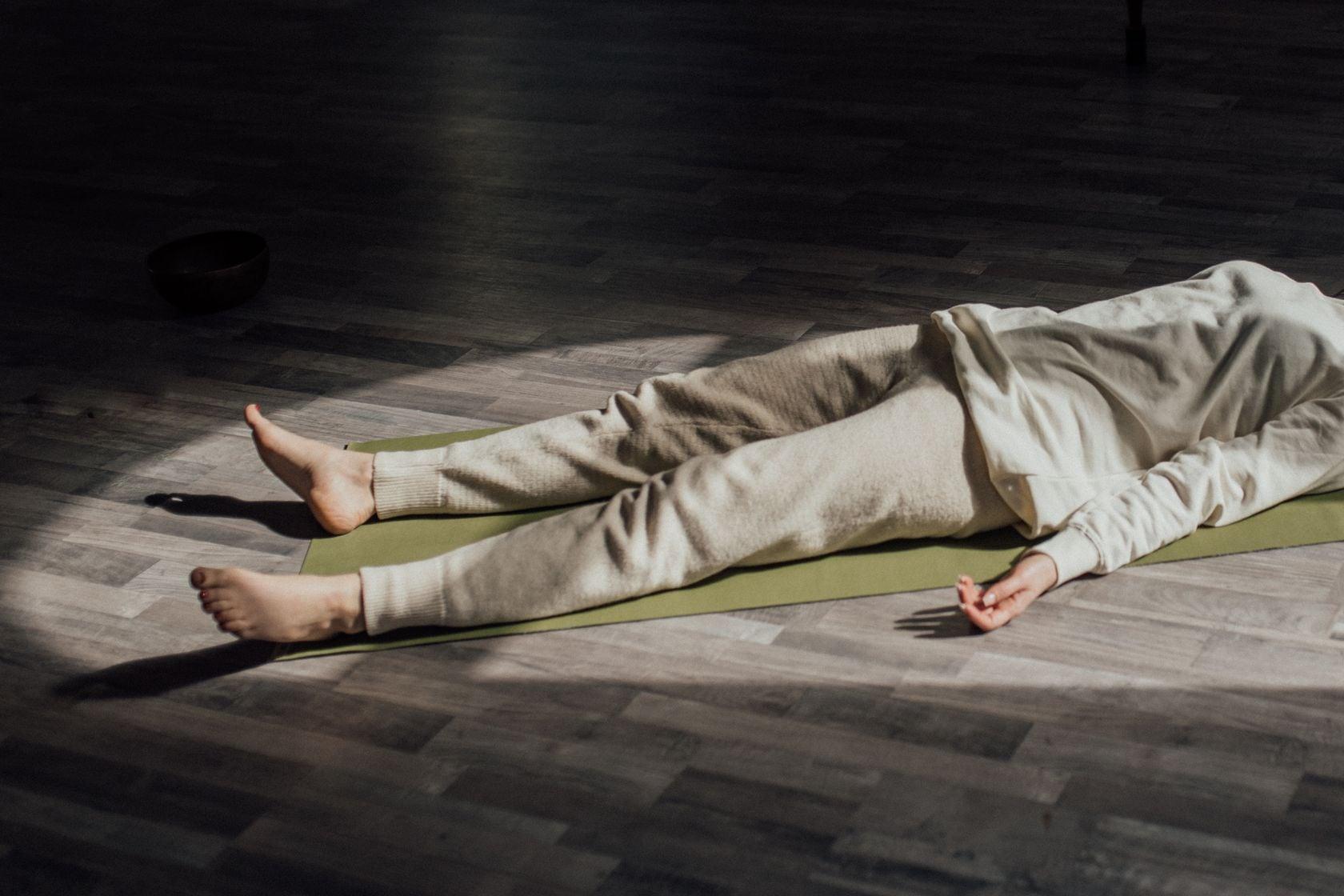
A 2022 review in the journal Sleep and Vigilance describes it as guided mental imagery combined with shavasana, the yoga posture in which you lie flat on your back. The goal is a profound state of relaxation that differs from sleep in one respect: you stay aware of your surroundings. [1]
Unlike a yoga class, it does not require any poses. [3]
How is yoga nidra different from meditation?
Cleveland Clinic yoga therapist Judi Bar draws two lines. Meditation is usually done sitting up, in a waking state. Yoga nidra is done lying down, and although it is guided like some meditation, it follows a very structured sequence. [2]
You do not have to decide what to do with your attention. A voice tells you where to put it next.
Where does yoga nidra come from?
The term is old. The 2022 review traces its first mention to the Upanishads, around 600 BCE, and notes a passage in the Mahabharata that associates the god Vishnu with yoga-nidra. [1]
The guided format you will find on an app is much newer. According to the same review, an updated and systematized version of the practice was introduced to the public in the 1960s through the writings of Swami Satyananda Saraswati. [1]
So when a recording calls itself thousands of years old, read that with care. The word is ancient. The script, with its body tour and breath counting, is about sixty years old. Later teachers have adapted it again: Cleveland Clinic outlines a 10-stage version credited to Richard Miller. [2]
What happens in a yoga nidra session?
Most recordings follow the same arc. The review lists these stages. [1]
Stage
What you do
Settle
Lie on your back with your eyes closed, arms and legs slightly apart, palms up
Intention
Silently repeat a short, positive resolution (a sankalpa) three times
Body tour
Move your attention from one body part to the next as the voice names each one
Breath
Watch and count your breaths without changing them
Opposites
Call up paired sensations such as heavy and light, or warm and cool
Imagery
Picture the scenes or objects the voice describes
Return
Repeat the intention, notice the sounds around you, stretch and open your eyes
Traditionally you keep still and stay awake for all of it, and a session usually lasts about 30 minutes to an hour. [1] Shorter versions exist, and researchers have tested one that is 11 minutes long. [4]
How to do yoga nidra for sleep tonight
You need a bed, a phone or speaker, and 10 to 20 minutes.
Choose a short recording. Bar suggests starting with 15 or 20 minutes and working up from there. [2]
Get ready for sleep first. Brush your teeth, set your alarm and dim the lights. When the recording ends you should have nothing left to do.
Lie on your back. Your bed is fine. A pillow under your knees is optional, and a blanket helps because the body tends to cool as it rests. A darker room or a sleep mask keeps distractions down. [2]
Press play and put the phone face down. Let the screen go dark.
Follow the voice loosely. When you notice you have drifted into planning tomorrow, go back to the last body part you heard named. There is nothing to get right.
Let sleep come if it comes. The traditional instruction is to stay awake, but at bedtime, falling asleep halfway through is a fine result. In one small sleep-lab study, 7 of 9 first-time practitioners fell asleep during a 30-minute session even though the recording asked them to stay awake. [7]
If the first night feels fidgety, that is normal. Bar's advice is to keep going if you struggle with your first session. [2]
For the intention, keep it short and in the present tense. Something as plain as "I rest easily" does the job.
Does yoga nidra help you sleep? What the research says
The honest summary is: possibly, a little, and the studies are still small.
The overall picture
A 2023 integrative review in the Journal of Nursing Scholarship gathered 29 studies that used yoga nidra, 12 of them randomized controlled trials. Most reported positive results. The reviewers still concluded that the studies differed too much in who took part, and in how long and how often people practiced, to support firm conclusions. They asked for larger studies with stronger designs. [3]
The 2022 review makes a similar point more bluntly, listing insufficient sample sizes and a lack of rigorous methodology among the field's problems. [1]
Self-rated sleep in everyday adults
The largest studies are online trials from one German research group.
In the first, 341 people listened to an 11-minute recording over 30 days and were compared with 430 people on a waiting list. The yoga nidra group reported lower stress, higher well-being and better sleep quality afterward. The effect sizes were very small to small, and the authors asked for future studies with active control groups. [4]
The follow-up trial, published in 2025, added that control: one group listened to 10 minutes of music. Over two months, the people assigned a 30-minute recording reported fewer sleep disturbances than the waiting-list group. For the 11-minute recording the difference fell just short of statistical significance. Effects were small again, people dropped out of every group, and the trial was not formally pre-registered. [5]
People with insomnia
A trial in India enrolled 41 adults with chronic insomnia. Twenty-one learned yoga nidra in five supervised sessions and then practiced at home. The other 20 received cognitive behavioral therapy for insomnia (CBT-I), the standard non-drug approach. Sleep diaries improved in both groups. But the trial had no untreated comparison group, only 30 of the 41 participants handed in complete diaries, and the authors' own conclusion was modest: yoga nidra is a good adjunct therapy. [6]
A sleep-lab study in the United States randomized 18 adults with self-reported insomnia to either a 30-minute yoga nidra recording or lying quietly. It found no difference between the groups in brain-wave activity, heart rate variability or the time taken to fall asleep. Breathing slowed in the yoga nidra group, a result that weakened once the statistics were adjusted for multiple comparisons. The authors describe yoga nidra as a candidate for further investigation. [7]
How much weight to give it
Yoga nidra is not an established treatment for insomnia. The US National Center for Complementary and Integrative Health (NCCIH) notes that guidelines strongly recommend CBT-I as the first treatment for chronic insomnia, that relaxation techniques can be one part of it, and that relaxation techniques on their own do not look especially promising for sleep. [8]
One popular claim deserves a flag. You may hear that an hour of yoga nidra equals four hours of sleep. The 2022 review reports this as something practitioners say, citing a handbook, and does not test it. [1] Do not use yoga nidra to replace a night's sleep.
A fair reading: it is a pleasant, low-cost way to wind down, and some people feel they sleep better with it. It is not a reason to put off getting help for a sleep problem.
Is yoga nidra safe?
The NCCIH does not cover yoga nidra by name, but its guidance on close relatives such as guided imagery and progressive relaxation is reassuring: these techniques are generally considered safe for healthy people. Occasionally people report increased anxiety, intrusive thoughts or a fear of losing control. There are also rare reports of relaxation techniques causing or worsening symptoms in people with epilepsy, certain psychiatric conditions or a history of abuse or trauma. [8]
If a session leaves you more unsettled than when you started, stop. If any of those conditions apply to you, raise it with your doctor or therapist before you begin.
On sleep itself, the NHS advises seeing a doctor if changing your sleep habits has not helped, if you have had trouble sleeping for months, or if poor sleep is making daily life hard to manage. [9]
Pairing yoga nidra with a few minutes of foot pressure
Yoga nidra asks you to lie still. A few minutes of deliberate pressure on your feet beforehand draws a clear line between doing and resting. This is a ritual, not a therapy. Nobody has studied the combination, and we make no claim that it changes how you sleep.
Here is how to fit it in:
Before you press play, or during the spoken introduction, spend three to five minutes on your feet. Rub each sole firmly with your thumbs, as in our guide to massaging your own feet. Or press your soles into the footboard, or one sole against the other.
When the voice asks you to settle, stop. Uncross your legs and let your feet fall outward.
Stay still for the rest. The pressing is the last thing your body does on purpose that day.
If you like rubbing your feet before bed, our guide to massaging your own feet fits the same slot.
Where Somnisole fits
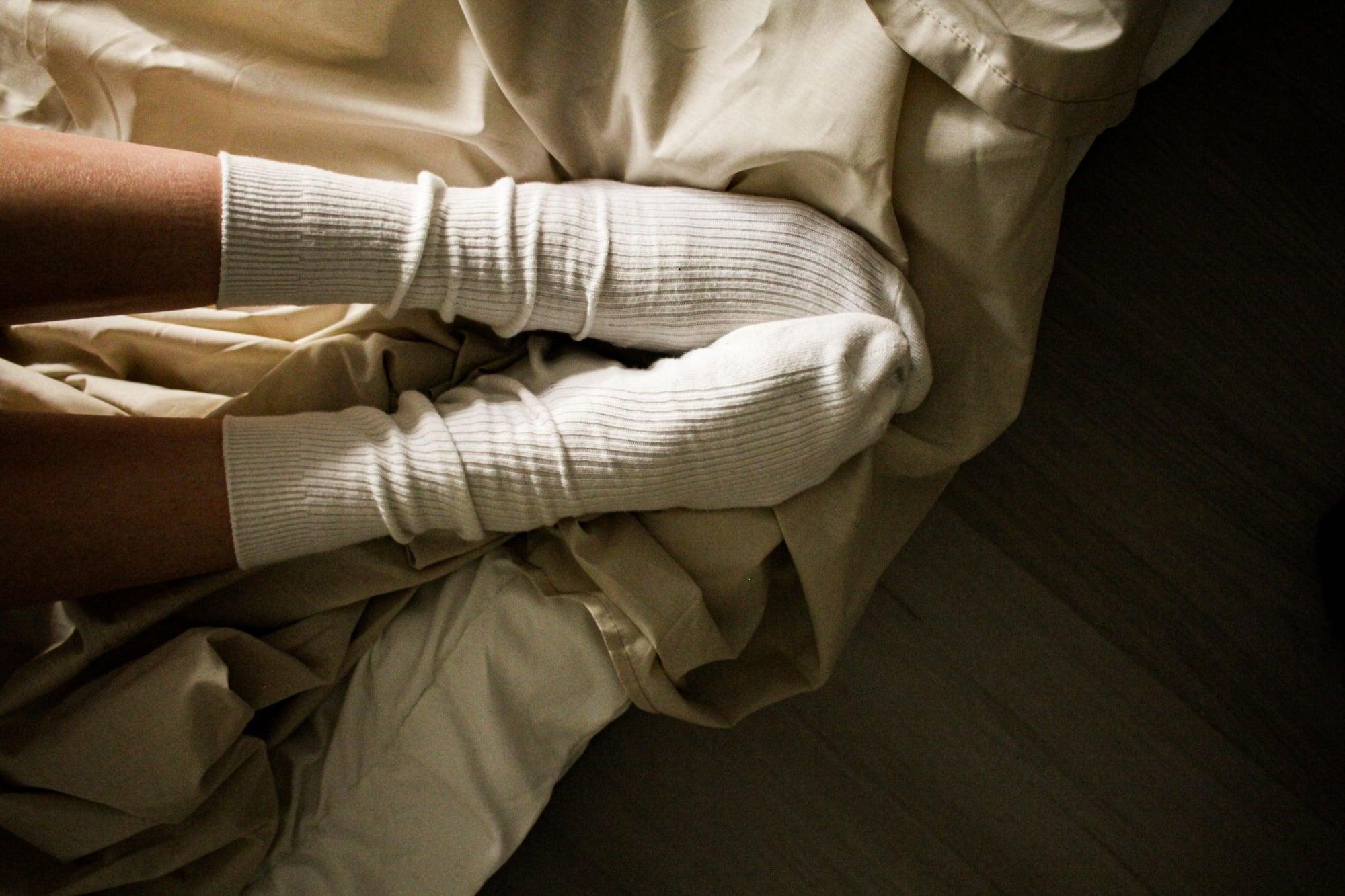
We make a sock for that first step, so weigh this part accordingly. Somnisole is a thin, breathable sock with 45 firm silicone nubs bonded inside the sole. You press your feet into a wall or footboard, press sole to sole, or glide one sole over the other foot's instep, and the nubs do the work your thumbs would. The how it works page shows each position.
One design detail matters for a practice done on your back: the nubs under the heel are softer, low domes, so you can rest your heels on the mattress when the pressing is over.
The heel area, where Somnisole uses softer low domes so back sleepers can rest on them.
The nubs are mapped to every reflexology zone. On a reflexology chart each area of the sole is traditionally associated with another part of the body, and the NCCIH says the claim that pressing those points brings relaxation and healing to those body parts has not been proven. [10] We offer the sock for what it plainly is: firm pressure for achy, tired, restless-feeling feet at bedtime, and a 5-minute wind-down ritual to do before the recording takes over.
Somnisole is a pre-order and has not shipped yet, so there are no customer reviews or test results to share. Not for feet with numbness, open wounds, diabetes-related foot problems or poor circulation without a doctor's OK.
Whether you use thumbs, a footboard or a sock, the order is the same. Press, settle, listen.
Common questions
What is yoga nidra?
Yoga nidra, often translated as yogic sleep, is a guided relaxation practice done lying on your back. A teacher or a recording leads you through a set sequence: an intention, a slow tour of attention around the body, breath awareness, paired sensations and imagery. The aim is deep relaxation while you remain aware of your surroundings.
Does yoga nidra help you sleep?
It may help some people feel that they sleep better, but the research is early. In one online study, people who used an 11-minute recording for 30 days reported slightly better sleep quality than a waiting-list group, with very small to small effects. A 2023 review of 29 studies found mostly positive results and still concluded that larger, stronger studies are needed.
Is it OK to fall asleep during yoga nidra?
The traditional instruction is to stay awake and aware. At bedtime, though, drifting off is a fine outcome if sleep is what you want. In one small sleep-lab study, 7 of 9 first-time practitioners fell asleep during a 30-minute session even though the recording asked them to stay awake.
How long should a yoga nidra session be?
Traditional sessions run about 30 minutes to an hour. A Cleveland Clinic yoga therapist suggests that beginners start with 15 or 20 minutes and build up, and researchers have tested recordings as short as 11 minutes. Choose a length you will actually repeat.
Can yoga nidra replace sleep?
No. You may hear that an hour of yoga nidra equals four hours of sleep, but a published review reports this as something practitioners say, not as a research finding. Use yoga nidra to rest and wind down, not as a substitute for a night's sleep.
Is yoga nidra a treatment for insomnia?
It has not been established as one. One small trial in people with chronic insomnia compared it with cognitive behavioral therapy and had no untreated comparison group, and its authors described yoga nidra as an adjunct. Guidelines recommend cognitive behavioral therapy as the first treatment for chronic insomnia, so if poor sleep has lasted for months, see a doctor.
10Reflexology. National Center for Complementary and Integrative Health (NCCIH), NIH. Accessed 2026-11-06.
The sock with the chart built in.
Somnisole puts firm silicone nubs over every zone of the sole, inside a sock thin and breathable enough to sleep in. Made for achy, tired, restless-feeling feet at bedtime.
Somnisole is a wellness product, not a medical device. Not for feet with numbness, open wounds, diabetes-related foot problems or poor circulation without a doctor's OK.