How to Give Yourself a Reflexology Foot Massage
Updated November 5, 2026 · 7 min read
The short answer
Sit comfortably, rest one foot on the opposite thigh and warm it up with a little oil. Then thumb-walk the sole from the toes down to the heel, and finish with the top of the foot and the ankle. Spend 5 to 10 minutes per foot at a pressure that feels firm but never sharp, and treat it as a relaxing ritual, not a medical treatment.
A foot massage is one of the few things you can do well for yourself with no equipment and no training. This routine borrows its main move, thumb-walking, from reflexology, and covers the whole foot in order: toes, toe groove, ball, arch, outer edge, heel, then the top. Allow 5 to 10 minutes per foot. Think of it as a wind-down ritual that feels good, not a treatment for anything.
Before you start
Get comfortable. Harvard Health's guide to self foot massage starts in a comfortable chair, with one leg bent and the foot resting on the opposite thigh [1]. Sitting up in bed against the headboard works too. Put a towel under the foot if you are using oil.
Use a little oil. Oil lets your thumbs glide instead of dragging the skin, and Harvard Health suggests rubbing lotion or oil over the whole foot first [1]. Any plain oil or lotion your skin tolerates will do. A coin-sized amount per foot is plenty.
Look before you press. A self-massage is a good moment to check your feet for blisters, corns and toenail problems [1]. Skip any area where the skin is broken.
Know when to skip it. A few situations call for a doctor's advice first. They are listed in the section on pressure, after the routine.
The main move: thumb-walking
Thumb-walking is reflexology's signature technique. In one clinical trial, the reflexology group received deep thumb-walking pressure, while the comparison group received a similar-looking foot manipulation without it [3].
Here is how to do it:
- Hold the foot steady with one hand.
- Rest the pad of your other thumb on the sole, slightly bent at the first joint.
- Press in, then straighten the thumb a little so it inches forward. Bend it again. Each step is tiny, about the width of a grain of rice.
- Keep the pressure steady and do not lift off between steps. Walk in straight lines, row by row, like mowing a small lawn.
If your thumbs tire quickly, Cleveland Clinic describes a simpler version: use your fingers and thumb to press your way up the foot, then repeat with your knuckles [2].
The routine: 5 to 10 minutes per foot
The chart notes in each step are tradition, not established anatomy. There is more on that after the routine.
1. Warm up (about 1 minute)
Spread the oil over the whole foot, including the toes, arch and heel [1]. Stroke from toes to ankle with both hands, firmly enough to move the skin. Circle the ankle slowly three times in each direction.
2. Toes (1 minute)
Take each toe between thumb and index finger. Squeeze along its length, roll the tip gently, then pull the toe back and forth and ease it apart from its neighbor. Harvard Health notes that this stretches the muscles underneath [1].
Chart note: the big toe is traditionally associated with the head, including the brain and sinuses [4].
3. Toe groove (30 seconds)
This is the crease where the toes meet the ball of the foot. Most people skip it. Thumb-walk along the groove from the big toe side to the little toe side, then back.
4. Ball of the foot (1 to 2 minutes)
Thumb-walk across the ball in rows, from the inner edge to the outer edge. For a deeper pass, Harvard Health suggests pressing your knuckles into the foot and kneading it as you would bread [1].
Chart note: reflexology charts draw a waistline halfway down the foot. The area above it, which includes the ball, is traditionally associated with the upper back and the organs related to it [4].
5. Inner arch (1 to 2 minutes)
Support the top of the foot and thumb-walk from the ball toward the heel along the arch. Use a little less pressure here than on the ball. Do three or four parallel lines.
Chart note: the area below the waistline is traditionally associated with the lower back and the internal organs, and charts draw the liver area larger on the right foot [4].
6. Outer edge (30 seconds to 1 minute)
Pinch the outer border of the foot between thumb and fingers and work from the little toe down to the heel. Then thumb-walk the same line on the sole side.
7. Heel (1 minute)
The heel pad is thick, so it can take more. Use your knuckles, or wrap your hand around the heel and squeeze, then thumb-walk around its rim.
Chart note: the heel is traditionally associated with the lower back [2].
8. Top of the foot and ankle (1 minute)
Lighten up. The skin here is thin and the bones and tendons sit close to the surface. Stroke with your fingertips in the channels between the long bones, from the toes toward the ankle. Circle around both ankle bones.
9. Finish (30 seconds)
Make three long, slow strokes over the whole foot, then hold it still between both hands for a breath or two. Switch feet. Wipe off any extra oil or pull on socks before you stand up.
How much pressure, and when to stop
Aim for firm and comfortable. You should be able to breathe slowly and keep your face relaxed. A satisfying ache is fine. Sharp, stabbing, burning or electric sensations mean stop.
Do not dig into tender spots. Reflexology tradition reads a tender spot as a message about a body part. When that idea was tested blind, reflexologists examining feet were very poor at telling which conditions people had [6]. If a spot is sore, the simplest explanation is that the spot is sore. Go lighter.
More is not better. The NCCIH says the risk of harm from massage appears to be low, that the rare serious side effects reported have sometimes involved vigorous massage, and that older people may be at higher risk [7]. Even professional reflexologists work with gentle pressure and expect you to speak up or stop the session at any time [9].
Skip it, or ask a doctor first, if any of these apply:
- a foot fracture, an unhealed wound or active gout in the foot [8]
- a current blood clot [8]
- pregnancy, osteoarthritis in the foot or ankle, or vascular disease in the legs or feet [8]
- diabetes-related foot problems or numbness, because nerve damage can stop you from feeling an injury [10]
Cleveland Clinic's general advice is to talk to your healthcare provider before trying reflexology [2]. And the NCCIH is clear that massage should not be used to postpone seeing a provider about a medical problem [7].
What the chart says, and what the evidence says
A reflexology chart gives the routine a pleasing structure, and following one is a good way to make sure no part of the foot gets missed. It helps to be clear about what the chart is.
The NCCIH states that the claim that pressing foot points causes relaxation and healing in matching parts of the body has not been proven [5]. A 2015 review found that earlier systematic reviews had failed to show concrete evidence of any specific effect of reflexology in any condition [4]. Cleveland Clinic adds that no well-designed studies show reflexology to be better than an ordinary foot massage [2].
What people reliably report is more modest and more useful: having your feet pressed and rubbed feels good and is relaxing. That is reason enough to do it. For more on the map itself, see our guide to pressure points on the feet.
The hands-free version
Two things limit a self-massage. Your thumbs get tired, and it is hard to reach your own feet once you are lying down.
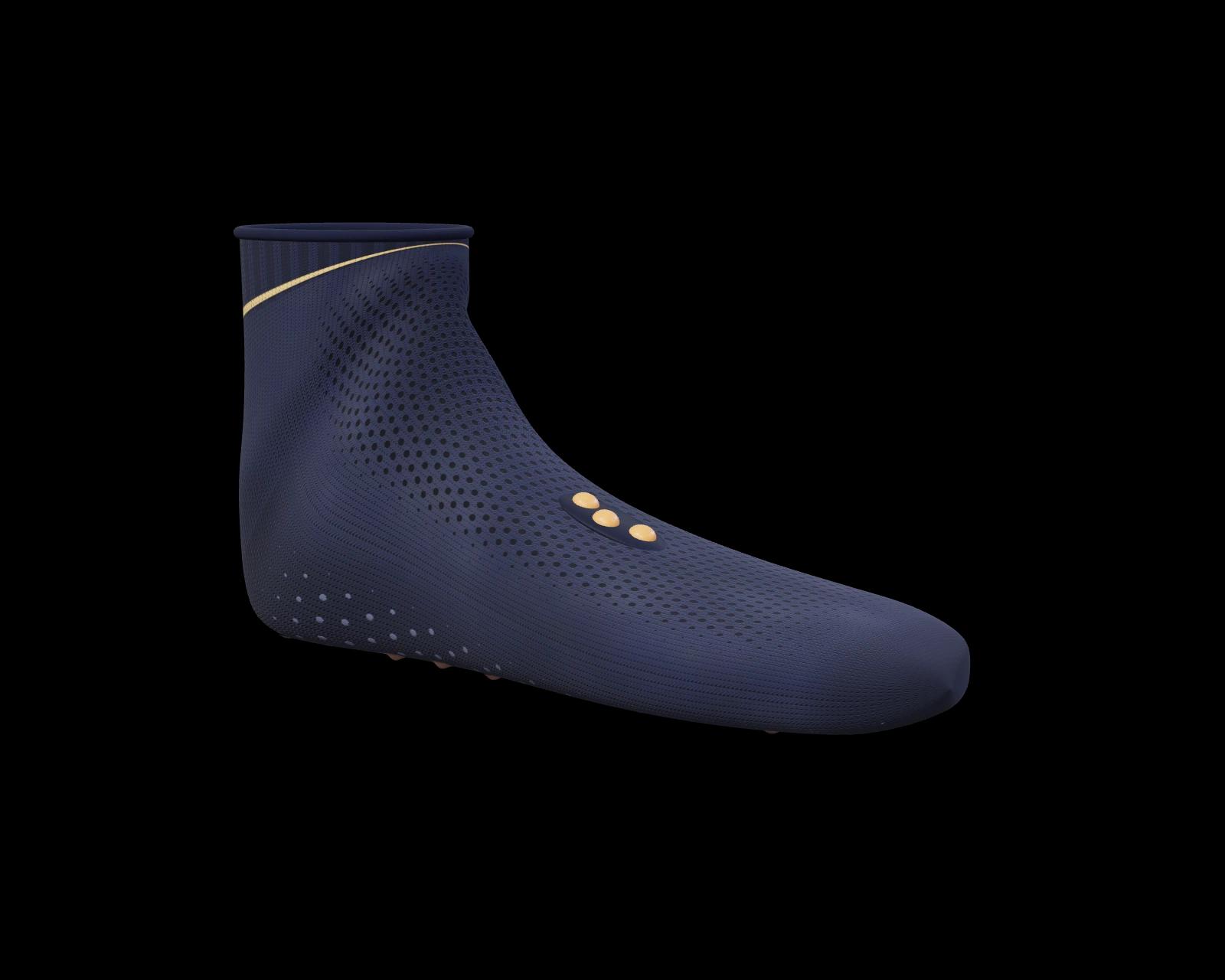
Somnisole is the hands-free version of the same idea. It is a thin, breathable sock you can sleep in, with 45 firm silicone nubs bonded inside the sole along the same route as this routine: toes, toe groove, ball, inner arch, outer edge and heel. Larger thumb nubs sit at the centers of the ball and arch, and softer low domes cover the heel. In place of walking a thumb across the sole, you press your foot into a wall or footboard, press sole to sole, or glide one sole over the other foot's instep, where a small pad of three nubs sits.
It is made for achy, tired, restless-feeling feet at bedtime, as a 5-minute wind-down ritual. It is a pre-order and has not shipped yet, so we have no reviews or test results to share. Not for feet with numbness, open wounds, diabetes-related foot problems or poor circulation without a doctor's OK.
You can see the three positions on our how it works page, or read the reflexology socks guide for how nub socks compare with printed chart socks.
Common questions
How long should a foot massage last?
For a self-massage, 5 to 10 minutes per foot is enough to cover the whole foot without tiring your hands. Professional reflexology sessions generally last 30 to 60 minutes, according to the University of Minnesota. There is no researched minimum, so let comfort decide.
What does it mean if a reflexology point hurts?
Reflexology tradition reads a tender spot as a sign about the body part it is traditionally associated with, but that idea did not hold up when tested. In a blinded study, reflexologists examining feet could not reliably tell which health conditions people had. A tender spot most likely means that part of your foot is sore, so ease off, and see a doctor if the pain persists.
How often should you do reflexology on your feet?
There is no researched dose. A gentle self-massage can be a nightly habit if it feels good and your feet are healthy. If your feet feel bruised or sore the next day, use less pressure or take a day off.
When should you not do reflexology?
Skip it on a foot with a fracture, an unhealed wound or active gout, and if you have a current blood clot. Check with a doctor first if you are pregnant, or if you have foot or ankle arthritis, vascular disease, diabetes-related foot problems or numbness in your feet.
Should I use oil or lotion?
Either works. A little oil or lotion lets your thumbs glide instead of dragging the skin, and a coin-sized amount per foot is plenty. Choose one your skin tolerates, and wipe your feet or put on socks afterward so you do not slip.
Is there a pressure point in your foot?
Reflexology charts mark many points on the feet, each traditionally associated with a part of the body. Research has not shown that pressing them affects those body parts. What people reliably report is simpler: firm pressure on the sole feels good.
Sources
- 1Foot massage: The pause that refreshes and is good for you!. Harvard Health Publishing, Harvard Medical School. Accessed 2026-11-05.
- 2Reflexology: What It Is and How It Works. Cleveland Clinic Health Essentials. Accessed 2026-11-05.
- 3Health-Related Quality-of-Life Outcomes: A Reflexology Trial With Patients With Advanced-Stage Breast Cancer. Oncology Nursing Forum, 2012. Accessed 2026-11-05.
- 4Revisiting reflexology: Concept, evidence, current practice, and practitioner training. Journal of Traditional and Complementary Medicine, 2015. Accessed 2026-11-05.
- 5Reflexology. National Center for Complementary and Integrative Health (NCCIH), NIH. Accessed 2026-11-05.
- 6A blinded investigation into the accuracy of reflexology charts. Complementary Therapies in Medicine, 2000 (PubMed abstract). Accessed 2026-11-05.
- 7Massage Therapy: What You Need To Know. National Center for Complementary and Integrative Health (NCCIH), NIH. Accessed 2026-11-05.
- 8Are There Times When I Shouldn't Have Reflexology?. University of Minnesota, Taking Charge of Your Wellbeing. Accessed 2026-11-05.
- 9What Can I Expect in a First Reflexology Visit?. University of Minnesota, Taking Charge of Your Wellbeing. Accessed 2026-11-05.
- 10Diabetes & Foot Problems. National Institute of Diabetes and Digestive and Kidney Diseases (NIDDK), NIH. Accessed 2026-11-05.
The sock with the chart built in.
Somnisole puts firm silicone nubs over every zone of the sole, inside a sock thin and breathable enough to sleep in. Made for achy, tired, restless-feeling feet at bedtime.
Somnisole is a wellness product, not a medical device. Not for feet with numbness, open wounds, diabetes-related foot problems or poor circulation without a doctor's OK.
Keep reading: the foot reflexology chart or all articles.